

I supply the people behind the graphics.
I supply advertising materials to local print shops and sign companies. Most of my customers buy rolls for shop windows, storefront promotions and vehicle graphics.
They come to me with an application and a deadline. I need to recommend a material they can print, install and deliver with confidence.
The campaign ended.
The removal did not go as planned.
Then a customer contacted me about a shop-window promotion. The campaign was over, but removing the graphic was taking longer than expected and leaving adhesive behind.
My first thought was to replace the material. But I could not tell whether the problem came from the adhesive, the glass surface, the installation conditions or the length of time it had been in place.
I didn’t want to buy another roll and face the same question again.
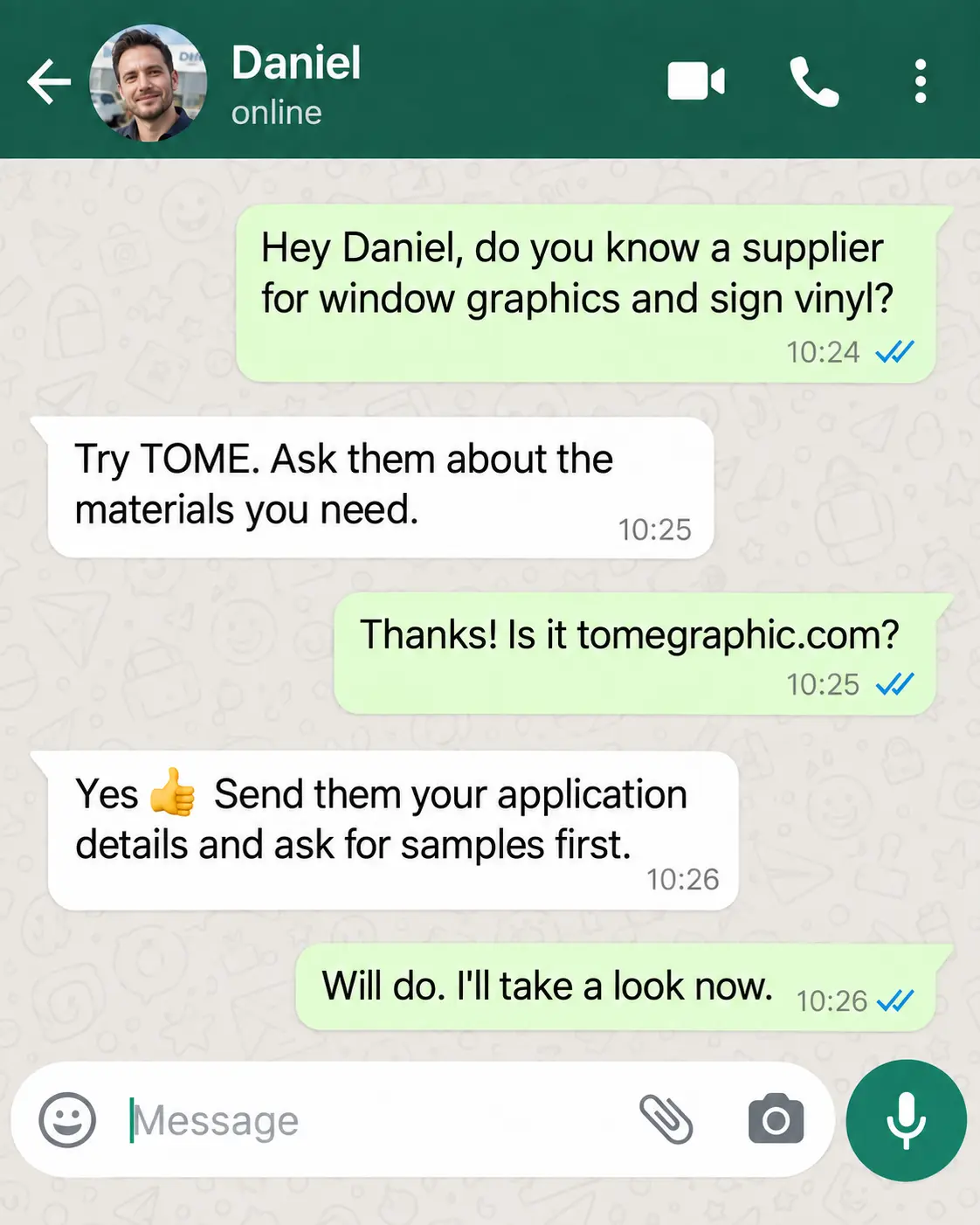
A recommendation led me to search.
I asked people I knew in the industry whether they had a supplier worth speaking to. A friend suggested TOME. I searched for tomegraphic on Google and looked through the material applications on the website.
The recommendation gave me a starting point. What made me get in touch was seeing applications close to the jobs my own customers were doing.
They asked about the job
before recommending a material.
I explained what my customer had experienced, which material we were using and what I needed from a replacement. I expected to receive a price list. Instead, the salesperson began by asking about the job.
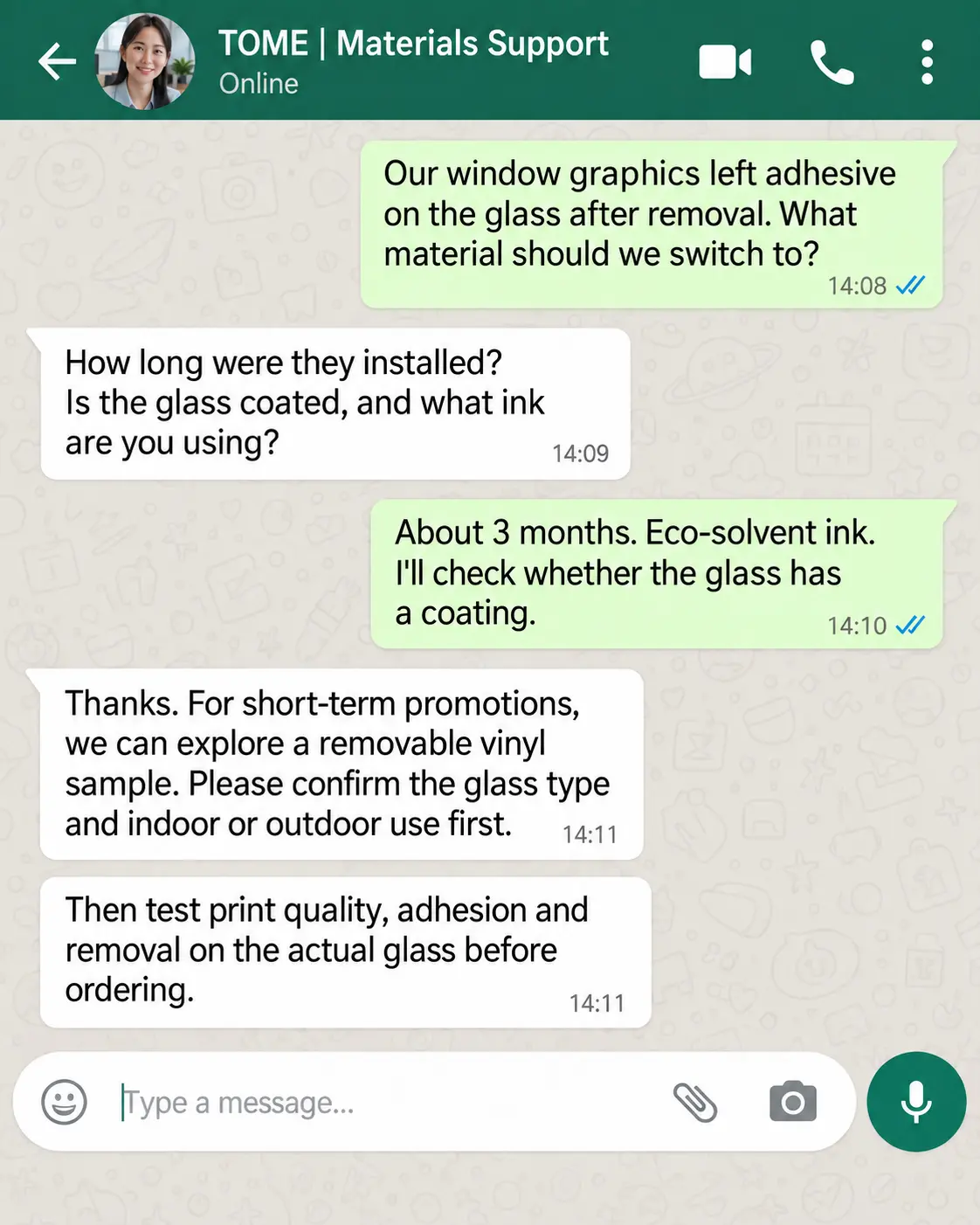
Those questions made me go back to my customer for details I had not collected before. “Window graphics” was no longer a complete brief.

Same vinyl category.
Different customer requirements.
The salesperson explained the differences through the jobs I was supplying. I began to understand why a material that made sense for one order might not suit the next.
A graphic that needs to stay
I need to confirm the surface, exposure and expected service period—not just ask for “strong glue.”
A promotion that needs to change
Removal becomes part of the requirement. A removable adhesive is a candidate to test, not a promise of residue-free removal on every surface.
A demanding industrial or vehicle surface
The substrate and coating matter. I need to share those details and test adhesion before recommending a high-tack option.
I started with a material problem. I came away with better questions for my customers.
The product details
began to mean something.
They showed me product details and application videos, and explained the differences in the face film, adhesive and liner. The factory information was useful background, but I paid more attention to how the material related to my customer’s work.
We also discussed my country’s market and the applications I sell most often. I wanted recommendations based on those jobs, rather than stocking a material simply because it was described as a popular seller.
For the window promotion, I wanted to evaluate a removable option. For longer-term flat graphics and industrial surfaces, I kept separate requirements. The shortlist finally had a reason behind it.
A sample first.
Then a buying decision.
The information helped, but I was not ready to make a bulk purchase from a conversation alone. I decided to start with a sample and test it under the conditions my customers actually use.
 01
Print it
Use the intended printer and ink. Look at color, detail and media feeding.
 02
Apply it
Use the actual surface. Check adhesion, edges and removal where required.
 03
Confirm it
Agree on the construction, roll size, quantity, packaging and lead time.
I also wanted the sample specification recorded, so that any order could be checked against what we had agreed to test.
Now I know what I need to find out.
I began this search because a customer had a problem I could not confidently answer. My next step is to test the sample—not to assume the problem is already solved.
The difference is that I now know what to ask, what to compare and what to confirm before placing an order.


